Freepik Biology Diagrams

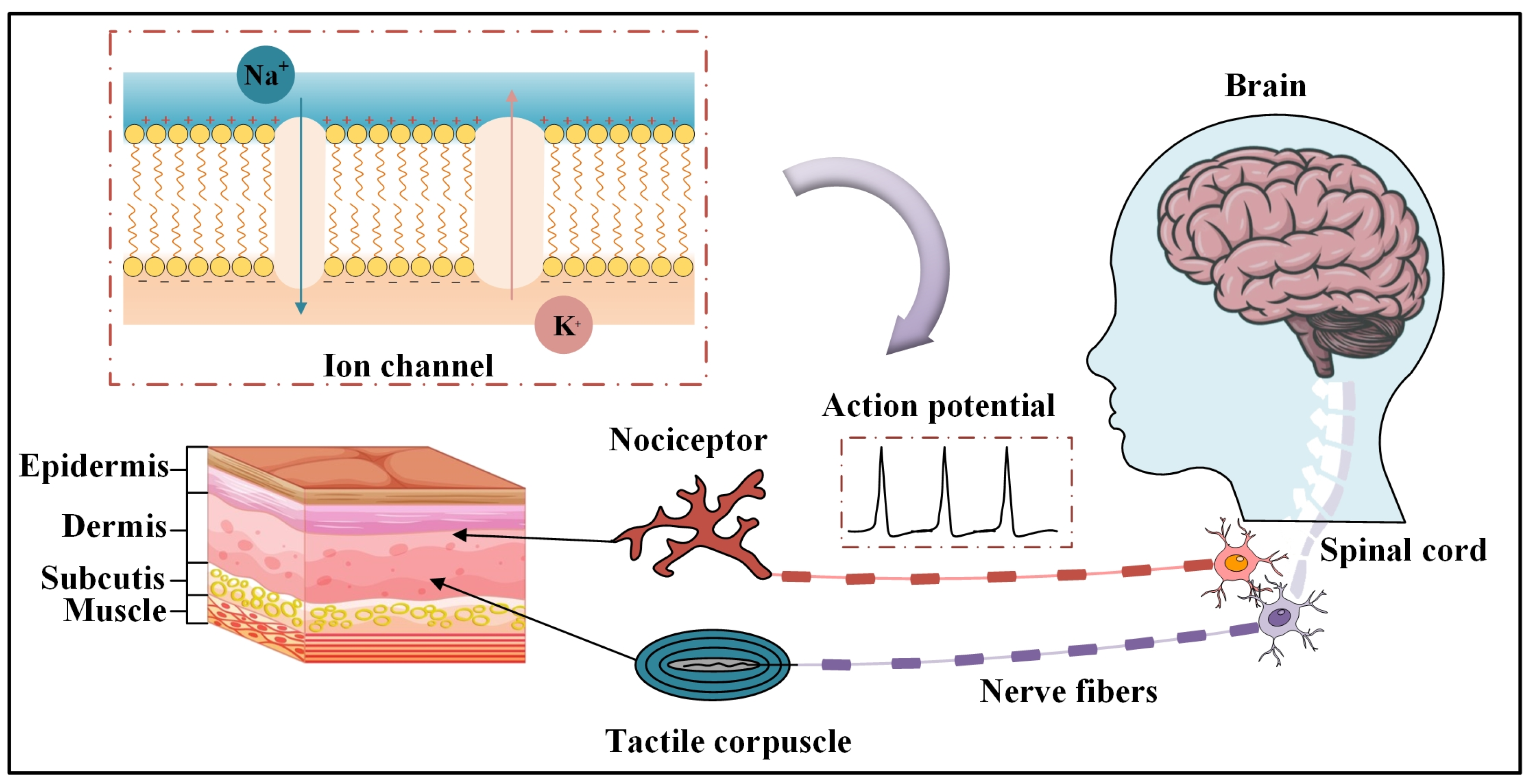
Freepik Biology Diagrams We know very little about how and where the affective aspects of tactile perception are processed in the nervous system. The nociceptive afferents convey information about sharp and dull pain, and a specialized receptor type conveys information about skin irritants and itch. All of these afferent fiber types have slow conduction velocities

Pain modulation occurs at various levels in the sensory pathway, influenced by treatments such as local anesthetics and NSAIDs. 4.5: References This page offers an array of references on sensory receptors and pain perception, covering tactile receptors, sensory adaptation, spinal neurotransmission, and referred pain mechanisms. Sensory receptors are classified into five categories: mechanoreceptors, thermoreceptors, proprioceptors, pain receptors, and chemoreceptors. These categories are based on the nature of stimuli each receptor class transduces. What is commonly referred to as "touch" involves more than one kind of stimulus and more than one kind of receptor. Pain is a sensory and emotional experience that is personal and unique to an individual. Nociception is different from pain and considers the neural process of encoding and processing noxious stimuli. Anatomically noxious stimuli are transduced by nociceptors to an electrical signal carried by first-order neurons to the dorsal horn of the spinal cord. From the spinal cord second-order neurons
Tactile Stimulation: Key Insights for Brain and Body Biology Diagrams
Recent studies illustrate that tactile perception involves various types of receptors such as mechanoreceptors, thermoreceptors, and nociceptors. These receptors work in conjunction to send signals through neural pathways to the brain, allowing an organism to interpret different textures, temperatures, and pain sensations. Pain is an experience related to actual or potential tissue damage that contains multiple sensory, affective, cognitive and motor components. 160 While both touch and pain are somatosensory sensations detected by specialized receptors on the skin, the precise brain region that encodes the perception of pain has not yet been definitively Tactile receptors in mammals: Cutaneous tactile receptors differentiate into innocuous touch supported by multiple receptors with low mechanical threshold (LTMRs) in glabrous and hairy skin and noxious touch supported by high mechanical threshold receptor (HTMRs). The perception of pain. In: Kandel ER, Schwartz JH, Jessell TM, eds

The sensations of touch and pain get perceived by cutaneous low threshold mechanoreceptors (LTMs) in the skin. These cells convert tactile stimuli into membrane action potentials that then trigger neuronal action potentials. These LTMs can adapt and transmit sensations to sensory neurons, which project to the spinal cord at the dorsal horn to relay light touch or to the lateral spinothalamic